Showing posts with label japanese food. Show all posts

Tuesday, December 27, 2011

I'm Just the Curry-ier, Ma'am.


It finally turned cold here in central Texas last week, and even then it's short lived - we'll be in the middle sixties by the end of the week. Being from a more northerly clime, I greatly enjoy these bursts of cold (sometimes foul) weather more than some of my neighbors (okay, most of them).


Due to the cold weather last night and an overabundance of desire to do so, I made more curry today. Most of the days between blog posts are taken up with other foods - misoni pork, oden and other nimono, the odd pizza or bowl of ramen - but this felt like it was going to be a curry day. I'm assuming it was on my mind because of both the cold weather and this video the Wife sent me last week. We had discussed making some changes to our home curry recipe, a la JMSDF ships and their post WWII traditions.


Just like everyone's grandma's way of making pot roast or mama's spaghetti sauce secrets, every ship's cook in the JMSDF has a specific way in which they make curry sauce. Curry sauce (as I explained briefly before) was introduced by the British in the late 1800s, then morphed over the course of time to become so popular that it's now considered a national dish. In the early parts of the 1900s, the IJN began a practice that would become a weekly tradition. Ships would have lots of scraps of vegetables and meat saved up from cooking during the week, and various other things that needed some use: tomato sauce, worchestershire sauce, bread crumbs, you name it it was possibly in the galley. Cooks would make curry rice based upon these leftovers and sundry herbs and spices, all made in a thick lard-and-flour-based gravy.


After WWII, the dish continued to skyrocket in popularity to the point where in the 1960s when viable 'roux blocks' of curry began to be sold in supermarkets. Suddenly, you didn't have to spend hours mixing your own sauce and tending the stove twice (or three times if you still used a traditional rice pot) in order to make what was really a simple dish, if you even knew how to make it.


So I did some of my prep last night by chopping up some veggies and mixing my dry spices and flour. Instead of my usual mix of straight curry powder and flour, I went with curry powder, garam masala and flour. This morning, I made some quick beef stock (I have got to get rid of this free instant broth somehow), made my roux block, and  sautéd the vegetables and beef in butter before the usual steps of adding and boiling the beef stock, then adding the roe and letting it start to thicken.


This is where things took their second different turn: I added about five tablespoons of Bulldog chuno sauce, three tablespoons of honey and half of an apple's worth of apple puré  (made directly over the pot with an oroshigane. After simmering for about forty-five minutes, it was ready to eat.


Super spicy by Japanese standards, yet sweet and a little lighter than usual, it tastes like I'd imagine a combination of Java-brand super hot curry would if you mixed it with House-brand Vermont curry. Next time, I think I'll put some puréd tomatoes and maybe a little less garam masala in. Eventually, we'll find a mix that is specifically our home version. When that day comes, I'm not going to share it openly!


Final Ingredients:
5 cups beef stock
1/2 cup lard
2 Tbs butter
5 Tbs S&B Curry Powder
1 Tbs Garam Masala
5 Tbs Bulldog Chuno Sauce
3 Tbs Honey
4 Tbs Unsweetened Applesauce
2/3 Onion, finely chopped
1 1/2 Carrot, finely chopped
1 lb Beef Stew Meat, fine cut

Sunday, December 11, 2011

Skewered Views

Lunch today was a trio of skewers of salt flavored yakitori and a couple of onigiri (salted and grilled chicken thigh kebabs and rice balls respectively) washed down with some warmed sake that had been previously offered up on our kamidana and mitamaya here in the household. A warm belly with a little alcohol in it lends me to thinking, and thus writing. Often I'll tweek an ongoing fan-fiction project the wife and a friend are involved in with myself, but quite a few times it has led me to posting on this ol' blog.

There's no point in apologizing for a lack of updates. I've been extremely busy with the build up and consequential tasks of finals week here in the aviation electronics department where I attend classes. I've accomplished everything and performed to acceptable standards throughout my semester, and so I am now roughly 1/6th complete with my studies. A week of stressful studying and testing has resulted in a 3.0 GPA, which while more than sufficient to continue in my classes was less than I aspired to. Now that the first weekend of winter break is upon me, I have a few moments to eat my lunch and reflect upon some thoughts.

I made the commitment this week to study for and be ready to take the Japanese Language Proficiency Test level 4 within a year. It's a Japanese government certified and administered test, similar to the ELPT that incoming foreign students have to pass if they aren't native English speakers. It's by far not the hardest level to take (the ranges are at 5 being the lowest and 1 being nearly native/native level), but it is a serious undertaking. I'll need to study a large portion of vocabulary, written and spoken grammar, and something close to 300 individual kanji. To that end, the wife and I will be ordering at least one set of the JLPT practice flash cards we found on a webpage that gives clear indications of what to study (and comes with very good reviews).

Today the wife is away at work, fixing the problems created by a largely non-secular group of shoppers on the run-up to what has been a largely secular holiday. The traditions and attitudes observed by the folks here in central Texas come from a good place originally, but lately the snotty holier-than-thou attitudes that have been exhibited and observed have begun to taint an already touchy subject for me. There seems to be a culture of expectant gift-giving here in the U.S. which translates (at times) down to "Gimme something because you should, but don't necessarily expect anything in return." Not everyone is guilty of this of course, but it seems to be more noticeable from year to year.

I like the Japanese take on New Year's and mid year times: giving presents has become a thing one does (especially when visiting a friend or their family), but is not openly expected. If one receives a gift, they are indebted, beholden in a tiny way to the gift giver. This results in a small, healthy cycle of politeness, gift exchanging and helpfulness. There's a social obligation to someone who shared their wealth with you, especially if you secretly needed that $300 your mother gave you while she was "stopping by on the holidays."

There's no need to expect that one would ever be given anything additional at this point in my life; after all, I have life, my own home (even if it's rented), a wife and pets, some useful widgets and a few toys of my own. So long as I have the basic needs of survival met, I really don't need anything else. I'm grateful when someone decides that they have something which they plan to give me, whether it is money or material goods. I'm indebted to them even if they intended nothing of the sort and expect nothing in return. Failing an ability to pay it back (such as monetary assistance from family members), I will pass it along as best I can, doing my level best to be helpful and contributory to society and its members.

Maybe that's what I'm failing to see from most folks, for whatever reason. Some of them must surely feel similarly, or else charity would have fallen flat in this past year of economic crisis. I hope that I'm only missing seeing the good, and not just seeing only what there really is to so many of the people I come across in my daily life....

Sunday, November 27, 2011

Tempura-ry Diet Change

Thinking of how we Americans traditionally eat, the wife and I have made a couple of small changes to our already different diet. The average American consumes more meat than any other being on the planet (although Australia is a close second). We generally consume more wheat than most folks in the world, as well as having some of the highest usage of trans fats to cook with.

Now, while I will fully admit that I have loved some butter-fried hamburgers in the past, over the course of the past year or two my tastes have dramatically shifted. My wife has expressed similar thoughts, and we're both concerned about our budget and our waist-lines. It's easy to fall into a comfort food trap, especially around the holidays. We already live in a stressful environment (learning to work on aircraft ain't easy!), we've bills to pay, all the usual complaints. Food has gotten wasted a couple times, sometimes without even being cooked. Our consumption of carbonated beverages and pain relievers has skyrocketed. Top that off with having been feeling too busy to properly cook, a long trip with the expectation that we're to gorge ourselves on roasted fowls and pigs (not to mention all the carbohydrate dense sides), and long hours at work for the wife, and things have begun to get a little ugly feeling.

So it's time for some things to change. I personally am on a quest to limit myself to only one single serving of soda per day, and replace my fluid consumption with water and tea. The wife is taking her lunch with her daily, and seems to prefer vegetarian dishes because of how much longer the vegetable fiber hangs around. When we're able, we'll be consuming more products from the sea, preferably grilled or steamed fish if we can't get decent sushi/sashimi grade.

One of the nicest ways in our experience to change (especially after a day like Thanksgiving Day) is having a day where you don't really eat. I'm not suggesting fasting (which does appear to have its health uses), just merely a change in consumption. We had that yesterday and we both felt immediately better, which to me made the oden I prepared all the more enjoyable. I think through the course of the day I had some leftover turkey, one bowl of rice with some edamame and that was it until dinner time. Granted, after dinner we slipped up a little bit and I procured some gyoza, but all in all we did much better for ourselves yesterday. We also discussed and began planning for having a week of mostly vegetable consumption, followed by (at least) several days of having a vegetarian diet.

I've been taken of late by shojin ryori, because quite literally it is the Zen of cooking. I'm not about to run off and take vows, but I am striving to better myself. The process of improving one's mind and soul is difficult, especially if you aren't feeling well. Meditation and exercise are most helpful, and will soon be the focus of some sort of plan to get and keep myself healthier. Stripping away soda and excess consumption seems to be a great start on the dietary end, but what else can I do to balance these principles with my love for tonkatsu or turkey and cornbread dressing? Perhaps a sort of detoxification on a culinary level might be needed. It makes sense to us in that light.

Tonight I didn't feel like cooking meat at all, although it's still on the menu for this week. I made a huge (by out standards) pot of vegetarian dashi and loaded it with shitake, nameko, and cremini mushrooms, then added a little soy sauce, mirin, and spring onion. It has made the entire house smell absolutely amazing!

Having that with some rice didn't seem like it would ultimately be very healthy, so I committed to making some vegetable tempura. I was too lazy to cut up the kabocha we bought in Austin, but I did slice up some onion and green beans, then skewer them along with some more mushrooms and cruciferous veggies. A quick turn through the batter and the fryer while I boiled some more edamame, and boom! a quick and easy dinner topped off by some takuan.


So here we are with a plate full of deep-fried goodness, ne? No, frying is not the absolute healthiest way to cook one's food. But this meal contains absolutely no animal products. It's got a large dose of fiber, a decent load of vitamins and minerals, and was quite satisfying on such a blustery, wind-swept evening as tonight. Tomorrow night, I will probably go ahead and make tonkatsu, given that I have very clean frying oil sitting in a pot on my stove and I'd hate to waste it by just throwing it away. After that, we're probably back to soup and vegetables for a while, with maybe some canned tuna or salmon thrown in if I'm in a crunch for time.

Saturday, November 26, 2011

Sons of Oden

With thanks to Manowar for the post title!

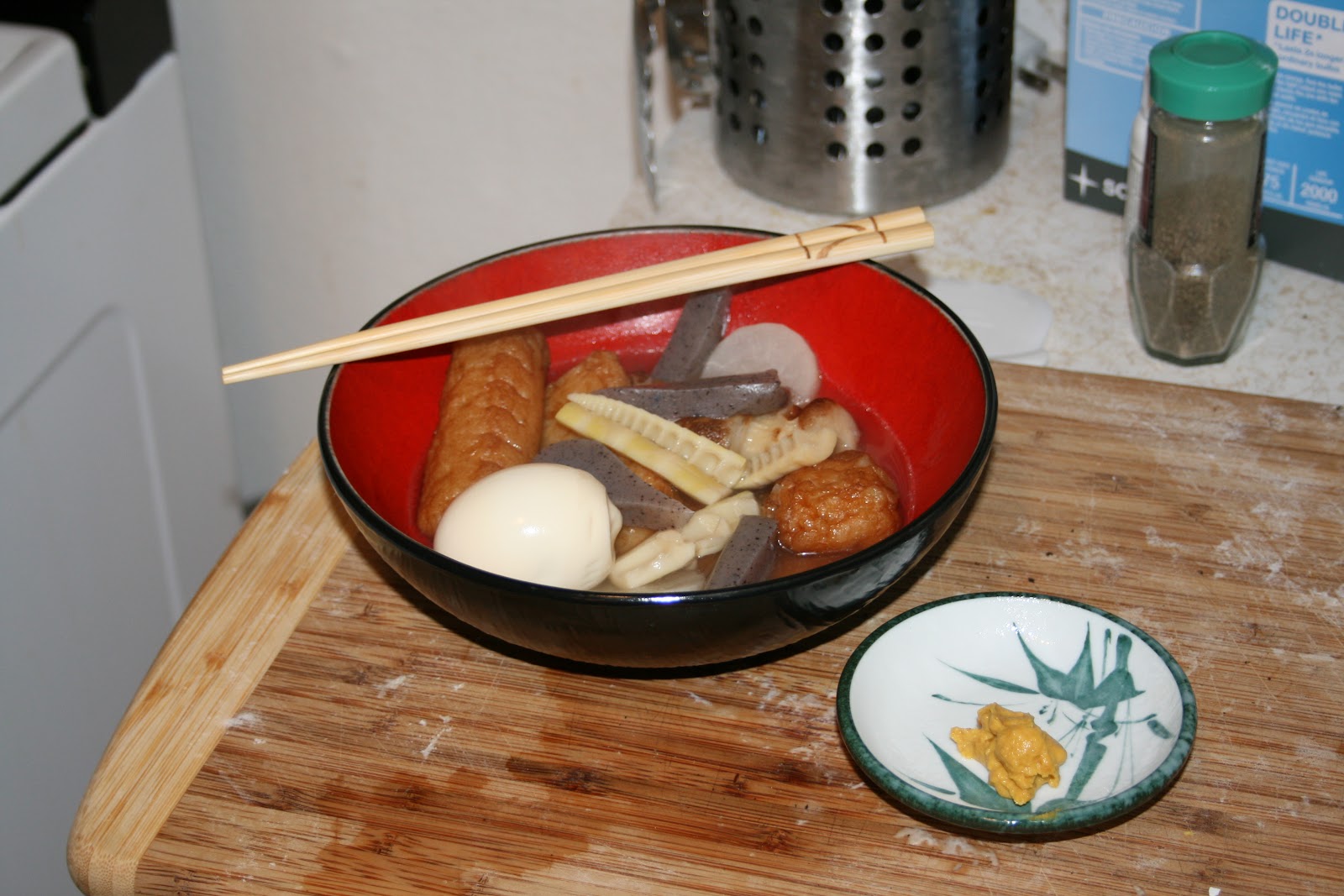
Tonight the weather here in Central Texas is a blustery, dry pre-winter cold that causes me to miss the northern climes (and real seasons for that matter) every year. Things are decidedly looking up, however, because I made oden tonight!

Oden is a staple of Japanese cuisine, especially in the cooler climates at the cooler months. The basics of it are that a family puts a bunch of related ingredients in a donabe and simmers them until they've mellowed and combined their flavors. Some of the most stereotypical things to include are easily available in small frozen trays in Japanese convenience stores and grocers. Heck, according to the internet, there are even canned single servings available from vending machines in major cities!

The wife and I purchased our smallish package of basic ingredients for about $3 US. Very straightforward, it has the time-consuming elements already contained within - fried goodies and a concentrated packet of "oden dashi (the soup base it simmers in). Following the instructions, I soaked my sand pot in some water for a bit first, then brought 800 ml of water to a simmer before adding all the ingredients. The package (made by Shirakiku) contained two of each of the major types of surimi based things and some good sized ganmodoki. I added some slivers of young bamboo shoots, several rounds cut from a daikon, two eggs, and a third of a block of sliced konnyaku to the pot.

To round it out, my serving included about a half a teaspoon of karashi, or hot "Chinese" mustard, and both the wife and I enjoyed Asahi "Super Dry" beer with our dinner.

It was immensely enjoyable! My favorite part had to be the gobomaki (burdock root rolled and cooked in fish paste), although the ganmodoki had to be a close second. I think that the next time I make this I'll be adding a lot more ingredients, and soon we'll find a combination that is exclusively our household's!

Sunday, November 20, 2011

Pickling

Tsukemono are a huge part of the average Japanese meal. They're one of the reasons you'll see a very pretty set meal that screams variety. All sorts are available for purchase in lots of grocery stores, and there are so many different recipes that it's most likely impossible to catalog them all.


Highly popular at all times, tsukemono are both a wonder and a potential health risk. Such things as the "seaweed salad" available at most sushi stands in the U.S. are relatively healthy and nutritive dense, but often loaded with calories as well. Then there's the fact that Japanese pickles use lots of vinegar, salt, and (sometimes) some carcinogenic elements. If you're eating takuan or fukujinzuke three or more times a day, you might have some health problems when you're older - Japan has the highest rate of digestive tract cancers in the world! 


Often, tsukemono is taken to mean pickle. In the traditional European sense that's not always the most correct word. Many are simple flavor combinations or treatments (like seaweed salads or nukadoko) meant to be consumed right away while others (like takuan or umeboshi) are truly preserved vegetables. Seeing as nukadoko ingredients can be hard to come by at times, I haven't taken that leap yet, though I plan to in the future.


Often used to stretch a meal, and just as often used as a "chopstick rest" much like sorbet or a cheese course between courses in a finer European style, there are plenty of reasons to keep a few simple ones around that can be used as okazu. I have a few standard ones that I keep in supply here in the house, and sometimes they're all one needs to have with a bowl of rice and some miso.


My favorite one is a simple fridge pickle of small kyuuri (small seedless cucumbers similar to those you'd make dill pickles with) and wakame in a vinegar dressing.


Recipe: Kyuuri to wakame aemono
Serves: 4 +


Ingredients:
3-6 seedless cucumbers
3-6 tablespoons fueru wakame
1 tablespoon kosher salt
4 tablespoons rice vinegar
1 tablespoon sugar


Slice the cucumbers as thinly as possible - I usually use a Benriner branded mandolin on a 1mm setting. Place in a bowl and sprinkle them with the salt, then rub the salt in and let them sit for a few moments to draw some of their moisture off.


Reconstitute the wakame and discard the water. Squeeze the excess water from the seaweed, and place in the bowl with the cucumbers. Add in the remaining ingredients, and stir to combine them. They're ready to consume in about an hour, but are best the next day.


Adjust the vinegar content as you like, depended on how pungent or sour you want your pickles to be. This usually lasts about a week in the fridge.

How To Enjoy: Curry

As I mentioned earlier, I've made a pot of curry today. While I posted the gluten-free recipe here, today I made it a little differently. There are a few minor differences like using all purpose wheat flour and a larger amount of solid ingredients, but things did change a little in the process. Probably the biggest difference in this pot versus the last I made has to be the curry powder I used. Previously, I've used S&B Oriental Curry Powder and a random Thai brand depended on what was available. This time I used a new container of cheap powder that's made for Chinese tastes instead.


There's more star anise and less cumin in this one than I'm used to, so the kitchen smells vaguely of five spice powder. This is absolutely not a problem, and it still tastes like liquid gold. Things came out a little runnier than I would've expected, but otherwise I can't complain about it.

There is a minor difference when talking about Japanese-style curry that most Americans don't pick up on. "Kare" simply is the spicy sauce, with or without vegetables. Most people think of "kare raisu" when they think of curry - sauce with extra ingredients ladled over rice. While if you just go to a place and order a plate of curry, you'll most likely get curry rice, there's plenty of extra ways to do this as a meal.

One of the oldest methods comes with curry itself from the British. You simply pour the sauce over a slice or two of bread and eat it like an open-faced sandwich, with or without anything other than the usual carrots, potato, and maybe meat. There's a drier form of curry which I have not made yet (simple called "dry curry;" Hiroyuki wrote about it in his blog last year), and of course serving curry stirred with udon or ladled out beside a fried meat cutlet (katsu curry).

My personal favorite has to be curry rice, but katsu curry comes in as a close second!

Adjustments

The past few weeks have been a mind-numbing, nerve wracking blur. I'm very busy with my studies in the Avionics department at TSTC - Waco. Prior to starting this course of study, I'd only dabbled in online classes since before I moved to Texas a few years ago. Probably the hardest part of it all has been keeping the various operating and maintenance frequencies and regulations straight between the installation class, systems class, and the electronics coursework.

Even though at the time I was very upset about not getting to transfer my job from down south (and thus becoming a member of the voluntarily unemployed), the fact that I've not been working has been a blessing in disguise. Yes, money has been tight the past month (and the only creatures who have been guaranteed a meal here are the cats). Yes, the wife now has a job, and is looking for better employment for herself that will use her skills. No, I'm not unhappy with things here, but I am consistently bothered by the fact that things in general could be better.

That has proven to be a source of internal strife. Social harmony is extremely important to me. I want things to go well and I want people to be happy, because that in turn makes me happy. The social cycle of passing on a courtesy done by someone else comes to mind; if someone does something nice for you (say, holding a door or excusing themselves if they need past you in an aisle), and you do something equally courteous when the situation arises, perhaps it will continue on.

I've felt like nothing but a resource whore the past two months. Even being polite to random strangers, helping people in need when it's within my means, keeping the food coming from the kitchen when the pantry gets low... somehow, it was failing to click. I felt awful, and was sure I was being awful.

Today is a day where I feel like I've accomplished a lot: I've made a huge pot of beef curry and a loaf of bread, I managed to send my wife to work with a packed lunch (though she had to heat it up herself before packing it in her thermal bento), and the laundry is halfway caught up. Between that and some time spent meditating, things are looking better. Hopefully after I finish my homework and do some studying tonight, I'll still feel this way about it!

Friday, October 7, 2011

Kabocha Soup

Last time the wife and I went to the Chinese grocery store down in Austin, we procured a nicely sized, deeply green type of pumpkin called a kabocha. Kabocha is one of those wonderful foods that have a multitude of uses for a huge variety of food styles; it can be steamed and sauced or battered and fried, anything really works so long as it's been cooked.

The older Japanese man who writes the only food blog I follow with any kind of dedication had put the bug in my ear that I needed to revisit this big ol' rock-hard winter squash with his mention of having made a soup out of one the week before. His picture of a half-empty tureen of smooth golden soup and a heavily coated ladle had intrigued me, but alas he'd posted no recipe!

Enter a few hours of searching on Google for recipes, and I finally had my way of going about it. It turned out so creamy and smooth that we both had a second helping before putting away the rest to give to my pumpkin-loving mother-in-law this weekend. I will warn you, however, that it's an extremely tough squash to cut cold, but this produced some of the most amazing soup ever that it was well worth the time I spent with sawing knife and cleaver.

Kabocha Soup

Ingredients:
1/2 Kabocha, seeded, peeled and cubed (1 inch chunks)
1 1/2 - 2 cups milk (I used soy again)
1/2 cup water
2 tablespoon cooking oil
1 tablespoon salt
1 tablespoon ground cinnamon
1 tablespoon ground ginger
1 teaspoon pepper

Preheat oven to 350 degrees and grease a shallow baking pan with the oil. Toss the kabocha chunks with the spices and oil before roasting for half an hour, turning once during cooking. After removing from the oven, blend with the milk and water in batches in a strong blender. Transfer to a stock pot and simmer.

Makes six to eight servings.

Saturday, August 27, 2011

Currying Favor

Last night I made pork curry rice at the wife's request. We've been putting it off all summer long because it's so blasted hot in central Texas this year, but finally our cravings outweighed our dislike of being warmed up.

In Japan, the most common way of making curry sauce (and thus curry rice) is to chop up your ingredients (often carrots, onion, and some form of potato or tuber, perhaps a little meat), saute them in some fat, then add water and some roux blocks (think of House or S&B) and cook until the sauce forms. Lots of folks still make their own from the way things appear, or else S&B probably wouldn't bother to continue producing a tinned curry powder.

Because of the Wife's foresight in purchasing large quantities of Tamanishiki Gold brand rice, we've got lots of high quality short-grain rice on hand. It's truly convenient to have our main starch just sitting in the pantry, not having to worry for two months at a stretch about running out (like we used to with bread). The one thing we were sadly missing was tsukemono to serve the curry rice with. Traditionally and taste-wise curry rice gets served with fukujinzuke or pickled rakkyo. I haven't tried it yet, but I suspect that it would go well with curry udon as well.

The recipe I use is adapted and tweaked from a translated article about the Imperial Japanese Navy's traditional form of curry served since before World War II. It was an expedient way to rid the galley of excess carrots, potatoes, onions and beef, and became a hallmark of their food services. Originally, the cooks made it more oily and thin than modern curry sauce (and I'd bet they did it to stretch the ingredients out).

The first time the wife and I tried going directly from the recipe, there was a large amount of excess fat to skim off of the surface. Since them, I've cut my recipe down in a lot of ways, and made it an ideal way to make dinner for four to six people. It keeps at least a week in the fridge if you seal it up nice and tightly.

Fortunately, you can profit from our mistakes and trials. If you need to make something gluten-free, I usually use rice flour (mochiko) and potato starch in a 4:1 ratio to replace wheat flour in gravies like this. Give it a shot - this is one of those times where gluten-free cooking doesn't leave some texture or flavor to be desired!

Curry Recipe:

Sauce -
4 Tbsp Curry powder
2 Tbsp Rice flour
1/2 Tbsp Corn or Potato starch
4 Tbsp Lard
32 oz. Beef Stock

Ingredients -
2 Lg Carrots, peeled and sliced
1 Med Potato, peeled and cubed
1 Sm Onion, peeled and diced
1 Tbsp Butter
OPTIONAL -1/2 Lb Meat (I prefer pork, any land animal will do!)

In a 1 quart sauce pan, melt the lard on medium high heat. Combine all the dry ingredients of the curry sauce and add to the melted lard. Stir and cook until it forms a thick paste, adding additional flour if needed. Set aside.

In a medium stock pot, melt the butter over high heat. Saute onions and carrots briefly, then add the potatoes and any meat. Continue to saute until ingredients are mostly cooked. When the onions are translucent, add all beef stock and bring to a boil. Add the curry roux and stir to combine. Bring close to a boil to thicken, then lower heat to medium-low and stir occasionally.

Serve over rice (count on needing 1/2 cup uncooked rice per person at a minimum) or udon (1 bundle per person).

Thursday, August 11, 2011

Tex-Mex Barbecue Onigiri

About four months ago, the wife and I were scratching our heads as to how to take care of some thinly sliced beef and mounds of freshly cooked short-grain rice (our house's staple starch due as much to dietary issues as our being a Shinto household). We rummaged through the refrigerator for about ten minutes before settling on skillet cooking strips of this thin beef with barbecue sauce and onions and serving it to ourselves in our large bowls, similar to gyudon. We jokingly named it "baabaakyuu don" and made it at least one more time before moving to our current location.

Fast forward to this week, and I've been given an amazing chunk of beef roast by my mother-in-law. The expense of such an item (even here in Texas) is enough to make me give a renewed dedication to not waste any gift, especially a housewarming present made of food. After I thawed it sufficiently, it went into the crock pot with some beef stock and a thinly sliced onion.

The debate began: how would the wife and I use it? We didn't have the ability to acquire more veggies to serve with it, so spinach, rice, noodles and carrots were our only options for sides. We finally resolved to make shredded barbecue out of it, and so I used some Jesse Dalton Barbecue Sauce and some brisket rub on it. That left me with my next question: what do we do with about two pounds of leftover beef barbecue?

The solution came to my wife yet again: the next day, she requested that instead of making plain onigiri I stuff them with some of the leftovers so her lunch wouldn't be so messy. I gave it a shot, loaded the rice into the press and "bingo!" we had created a new combination of foods for ourselves. I jokingly refer to it as "Tex-Mexanese" fusion cuisine.

To make it clear, if you want to make something like this, you need a good, strong flavored sauce that isn't too sweet - it gets lost in the rice and salt. Your best bet is to add only about a half a tablespoon's worth of filling to a standard, fit-in-your-palm rice ball, and to consume them quickly - I've made similar stuff in the past, and if it's too saucy or you let it sit for a while, the liquids will slowly seep out and stain the rice, change the flavor profile, or something else that may or may not effect the experience of eating these.

It was really quite a different combination - normally, I don't do much beyond plain rice, basic miso soup, and some sort of reasonably complex main or side dish. I would love to take pride in such a thing, but really that just feels a bit silly. I absolutely had to share it with the world, though. Hopefully someone finds the idea interesting enough to try.